Patient Retention Is the New Patient Acquisition — And How AI Makes It Happen
Updated: Jun 20

Acquiring a telemedicine patient costs 5x more than retaining one. Let that number sit for a moment.
You spent INR 800 on Google Ads, Instagram campaigns and SEO to get a patient to download your app, create an account and book their first teleconsultation. They consulted once, maybe twice. Then they vanished. No second visit, no follow-up, no chronic care subscription, no referral.
This is happening to 70% of telemedicine platforms in India right now — and almost nobody is talking about it, because the entire industry is still obsessed with acquisition metrics. Downloads. First consultations. MAU growth. But none of those numbers mean anything if the patient doesn't come back.
The retention gap — the market is booming, the patients aren't staying
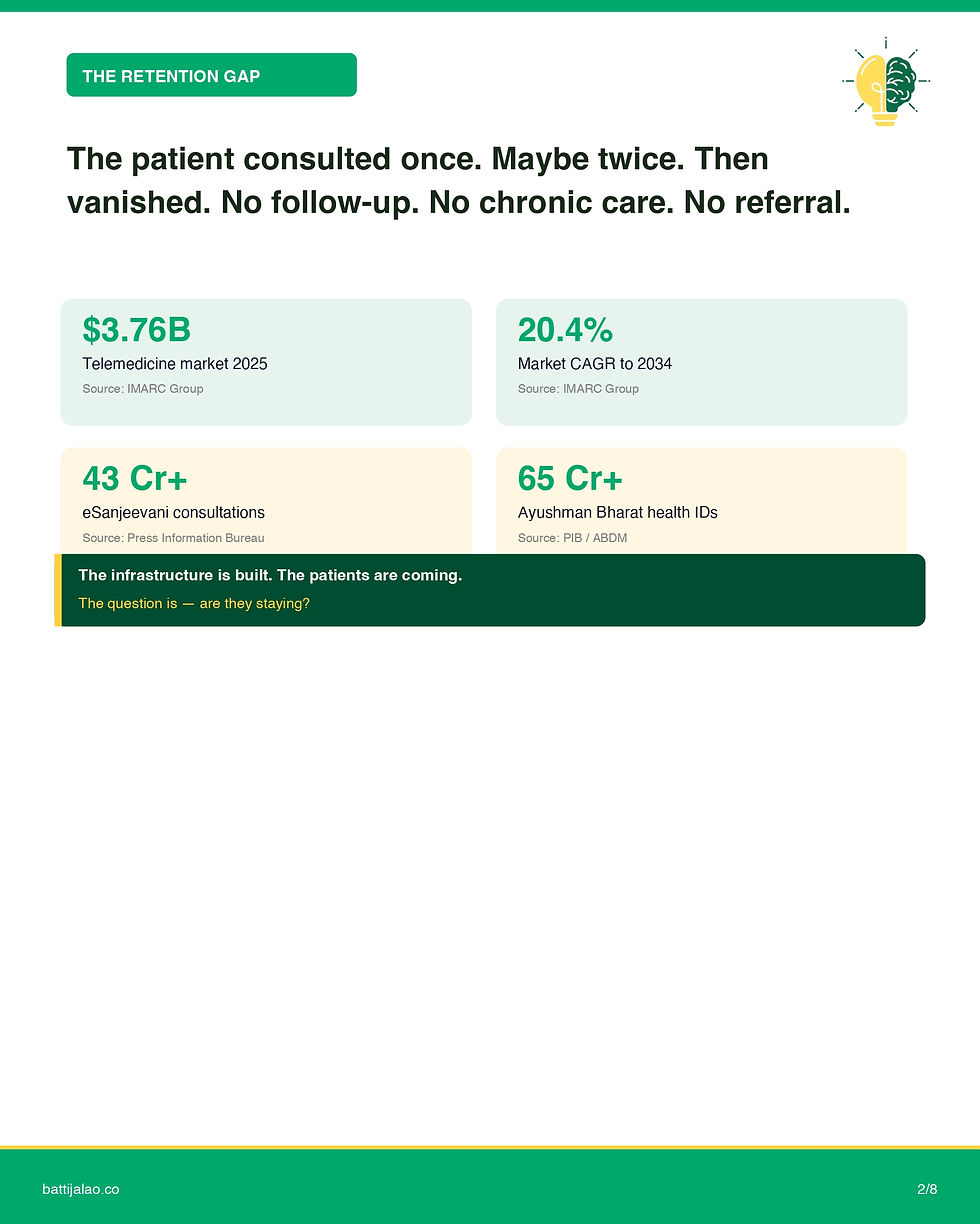
$3.76B
Telemedicine market size 2025
Source: IMARC Group
20.4%
Market CAGR to 2034
Source: IMARC Group
43 Cr+
eSanjeevani consultations
Source: Press Information Bureau
65 Cr+
Ayushman Bharat health IDs
Source: PIB / ABDM
The government is expanding telemedicine to 50,000 rural clinics. The infrastructure is built. The patients are coming. The question is — are they staying?
"The telemedicine platforms that will survive aren't the ones acquiring the most patients. They're the ones keeping them."
Acquisition fills the funnel. Retention builds the business. And in a market growing at 20.4% CAGR, the platforms that crack retention in 2026 won't just survive — they'll compound their advantage every quarter while competitors keep pouring money into the same leaky acquisition funnel.
The 5 AI-powered retention levers
1
AI engagement loops
Keep patients active between consultations.
A patient who consulted for a cough in January has no reason to open your app in March — unless you give them one. AI wellness nudges, medication reminders, and seasonal health tips keep your brand alive on their phone. Platforms with engagement loops see 3-4x higher monthly active retention.
Powered by BattiLynk AIBattiLynk AI generates the interlinked health content ecosystem that powers these nudges — blog posts, condition guides, and wellness tips with automated semantic linking. Every piece connects to the next, keeping patients inside your knowledge base instead of bouncing to Google.
Mordor: Chronic care = 47.7% of telemedicine revenue. Engagement drives it.

2
Chronic care SEO + AEO
Be the answer. Not just a result.
One-time fever consultations are low-value. Real LTV sits in chronic conditions — diabetes, hypertension, mental health, PCOS. These patients need monthly touchpoints for years. If your platform ranks for "online diabetes management" or "virtual psychiatrist India," you acquire patients who stay.
And beyond Google: when a patient asks ChatGPT "best online diabetes management in India," your platform needs to be the answer, not just one of the results. That's Answer Engine Optimisation — and most telemedicine platforms don't have it.
BattiLynk AI + BattiSenseBattiSense maps the exact questions chronic care patients ask — then generates FAQ content, JSON-LD Schema Markup, and PPA strategies that make your platform the cited answer when patients ask ChatGPT or Google's AI Overview.
Mordor: Mental health growing at 25.55% CAGR — highest in telemedicine

3
Subscription model marketing
Convert one-time consults into recurring revenue.
A teleconsultation at Rs.300 is a transaction. A chronic care subscription at Rs.999/month with unlimited consults, medication reminders, and quarterly reports is Rs.12,000/year — a 24x LTV multiplier from the same patient. Most platforms offer subscriptions but market them at the wrong moment.
Powered by BattiLynk AIAI identifies the optimal conversion moment — after the second consultation, when trust is built but before the patient drifts. BattiLynk AI creates the educational content (condition guides, treatment FAQs) that primes patients for subscription before the offer even appears.
MRFR: 70% prefer telemedicine for convenience. Convert preference into commitment.

4
Post-consultation nurture
The 48-hour window that decides everything.
Within 48 hours, a patient either opens your app again or forgets it. A WhatsApp consultation summary, a follow-up reminder for Day 7, a link to relevant health content — these aren't extras. They're retention infrastructure. The show-up rate for follow-ups jumps when patients get a personalised Day-2 check-in.
BattiLynk AI + BattiSenseThe nurture content itself is powered by BattiLynk AI — condition-specific articles, post-treatment guides, and wellness tips that are auto-interlinked to keep the patient engaged across multiple touchpoints. BattiSense ensures this content is AEO-optimised, so it's also discoverable by new patients searching the same condition.
50,000 rural clinics getting telemedicine — PIB. Retention at scale needs AI.

5
Churn prediction
Flag disengaged patients before they uninstall.
When a monthly patient goes silent for 3 weeks, that's not a data point — that's churn in progress. By the time they uninstall, it's too late. Re-acquisition costs 5x more than a single retention nudge sent two weeks earlier. AI models predict churn with 80%+ accuracy based on login frequency, consultation gaps, and content engagement.
BattiLynk AI + BattiSenseThe re-engagement content that brings patients back? BattiLynk AI generates personalised health updates and condition-specific nudges. BattiSense ensures your platform's content library ranks for the very queries churned patients search when they start looking elsewhere.
Patient-driven platforms at 21.97% CAGR — Mordor. Retention is the moat.

The bottom line

Acquisition fills the funnel.
Retention builds the business.
AI makes retention proactive.
India's telemedicine market is growing at 20.4% CAGR. But growth at the market level doesn't translate to growth at the platform level if patients consult once and leave. The platforms that will still be here in 2030 are the ones building retention infrastructure now — not waiting until their CAC makes the unit economics impossible.
Each of these five levers is a discrete intervention. Start with the one where your drop-off is highest. For most platforms, that's the 48-hour post-consultation window — because it's the easiest to fix and the most immediate in impact.
Join the Discussion: I’m breaking down the exact templates for this strategy over on LinkedIn.